Lesson 4 of 4 in Step 1 · First circuits
Direct and alternating current
By Mihai Dumitru · · 7 min read
On this page
Every circuit in this course runs on a battery, and a battery pushes current in one direction only. The socket in the wall works differently: its current keeps changing direction. This page explains the two kinds of current, what the numbers on a power adapter mean, and why electricity is sent across the country the way it is. It uses Ohm's law and the power formula.
Direct current
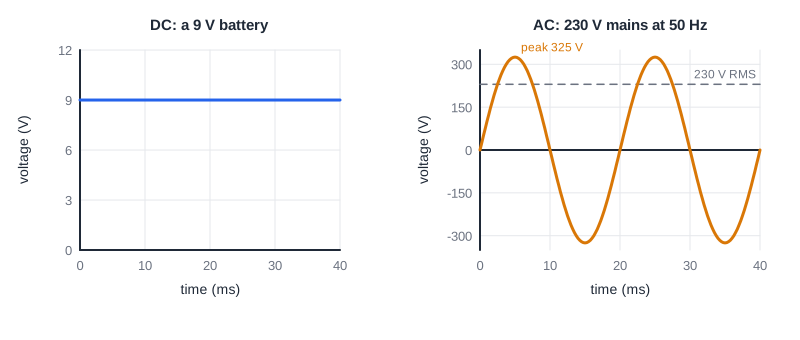
Direct current, or DC, flows in one direction only, from the positive terminal of the supply, around the circuit and back to the negative terminal. Batteries, solar panels and the USB port of a computer all give DC. Its voltage stays steady, apart from slowly falling as a battery runs down. Most electronics, from a phone to a pocket calculator, run on DC inside.
Alternating current
Alternating current, or AC, reverses its direction again and again. The voltage rises to a peak, falls through zero, rises to a peak in the opposite direction and comes back, in a smooth wave. One full wave is called a cycle, and the number of cycles each second is the frequency, measured in hertz (Hz).
In Romania and the rest of Europe the mains supply is 230 V at 50 Hz: fifty full cycles every second, so the current changes direction a hundred times a second. North America and some other countries use 120 V at 60 Hz. The wave is too fast to see, which is why a lamp on the mains looks perfectly steady.
What 230 V means
Because the AC voltage keeps changing, a single number needs explaining. The 230 V on the label is the RMS value, short for root mean square. It is the DC voltage that would heat a resistor by the same amount. The actual peaks are higher: for the smooth mains wave they are about 1.41 times the RMS value, so 230 V mains peaks at about 325 V in each direction. Multimeters on their AC setting show the RMS value.
Why the grid uses AC
Power stations are often far from the towns they supply, and the long wires between them have resistance. The power lost as heat in a wire is P = I × I × R, so it grows with the square of the current. To deliver the same power with less current, you need a higher voltage, because power is voltage times current.
Suppose 10 kW has to travel through power lines with a total resistance of 1 Ω. At 230 V the current is 10,000 ÷ 230 = 43.5 A, and the lines waste 43.5 × 43.5 × 1 = about 1,900 W, almost a fifth of the power. At 10,000 V the current is only 1 A and the lines waste 1 W. That is why power lines carry tens or hundreds of thousands of volts.
A transformer changes an AC voltage up or down with very little loss, using two coils of wire around an iron core. It only works with a changing current, so it needs AC. When the electricity grid was being built in the late nineteenth century, this was the deciding reason to use AC: step the voltage up for the long journey and down again before it reaches homes.
From the socket to your phone
A phone charger turns 230 V AC into about 5 V DC. Inside, a circuit lowers the voltage, and diodes let the current through in one direction only, which is called rectifying. A capacitor then smooths what is left into a steady DC voltage. The same steps, in different sizes, are inside every mains adapter.
Check yourself
What is the difference between DC and AC?
Show the answer
Direct current flows in one direction only, with a steady voltage. Alternating current keeps reversing direction, with a voltage that swings above and below zero in a smooth wave.
How many times a second does the current of a 50 Hz supply change direction?
Show the answer
Each cycle has two changes of direction, so 50 cycles a second means 100 changes of direction a second.
Why does the grid carry power at very high voltages?
Show the answer
For the same power, a higher voltage means a smaller current. The heat lost in the wires grows with the square of the current, so a smaller current wastes far less power.
What do the diodes inside a phone charger do?
Show the answer
They rectify the current: they let it through in one direction only, turning AC into DC that a capacitor then smooths.