From amber to the first electric machines
By Mihai Dumitru · · 6 min read
On this page
This series follows the story of electricity in the order it was discovered, from a curious effect of rubbed amber to the chips inside modern electronics. Each page covers one period and links to the lessons that explain the physics behind it. This first page covers the two thousand years before anyone could store electricity, let alone make it flow through a wire.
Amber
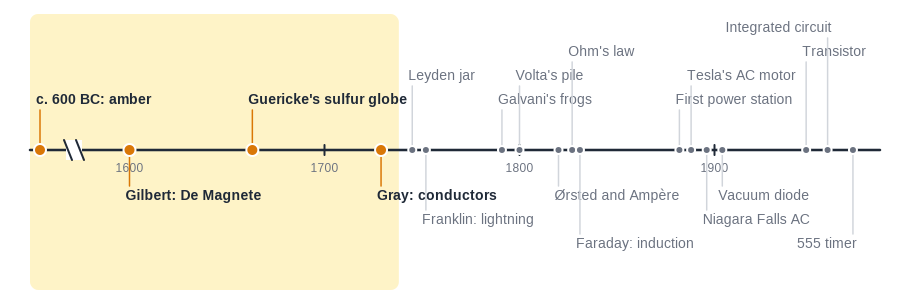
People in ancient Greece knew that a piece of amber, the hard fossil resin used in jewellery, attracts straws, feathers and dust after it has been rubbed with wool or fur. Tradition credits the philosopher Thales of Miletus, around 600 BC, with describing it, though none of his own writing survives. The Greek word for amber was elektron, and it is the root of every word in this course that starts with electr-.
For a very long time, that was all. Rubbed amber attracted light things, and a lodestone, a naturally magnetic rock, attracted iron. Many writers treated the two as the same kind of mystery.
William Gilbert, 1600
The first careful study came from William Gilbert, an English physician who later served Queen Elizabeth I. In 1600 he published De Magnete, a book on magnets and on the Earth as a giant magnet. In it he showed that the amber effect is something different from magnetism. A magnet attracts only iron, while rubbed amber attracts almost anything light. And many other materials behave like amber when rubbed: glass, sulfur, wax and various gems.
Gilbert called these materials electrica, Latin for "like amber". To detect the effect he made a light metal needle that could swing freely on a pivot, which turned towards any rubbed object brought close to it. It was the first instrument made for studying electricity. The English word electricity appeared a few decades later, in a book by Thomas Browne in 1646.
The first electric machines
Rubbing amber by hand produces only a little charge. Around 1663 Otto von Guericke, the mayor of Magdeburg in Germany, built a ball of sulfur on an axle and turned it with a crank while rubbing it with his hand. The spinning ball became strongly charged, attracting and repelling feathers and giving off faint sparks and glows. Through the following century such machines got bigger, with glass globes or plates and leather pads in place of a hand, and gave far stronger sparks.
Conductors and insulators
In 1729 the English experimenter Stephen Gray found that the electric effect could travel. He charged a glass tube and found that a cork stuck in its end attracted dust too. He then carried the effect along a thread for hundreds of feet, as long as the thread hung from silk loops. When he used brass wire to hang the thread, the effect vanished: the wire carried it away. Gray had found the difference between materials that let electricity pass, now called conductors, and materials that block it, now called insulators. Every circuit depends on that difference: copper wires to carry the current and plastic around them to keep it in.
A few years later, in 1733, the French scientist Charles du Fay found that there are two kinds of electric charge. Objects with the same kind repel each other, and objects with different kinds attract. He called them vitreous, from glass, and resinous, from amber. Today they are called positive and negative charge, names that come from the next part of the story.
What it means today
Static electricity, the kind these early experimenters studied, is charge that builds up on an object and stays there until it finds a path away, often as a spark. A balloon rubbed on a jumper, the crackle of a wool sweater and the shock from a door handle are all the same effect Gilbert described. A circuit is different: charge flows around a closed path, as the first circuit lesson explains. Getting from one to the other took another 160 years after Gilbert, and the first step was finding a way to store charge.
Check yourself
Where does the word electricity come from?
Show the answer
From elektron, the Greek word for amber, which attracts light objects after it has been rubbed. William Gilbert called similar materials electrica, "like amber".
What did Gilbert show about magnetism and the amber effect?
Show the answer
That they are different: a magnet attracts only iron, while rubbed amber and many other rubbed materials attract almost any light object.
What did Stephen Gray discover in 1729?
Show the answer
That the electric effect can travel along some materials, conductors such as thread and metal wire, but not along others, insulators such as silk.
How many kinds of charge did Charles du Fay find, and how do they behave?
Show the answer
Two kinds. Like charges repel each other and unlike charges attract. Today they are called positive and negative.