Lesson 6 of 6 in On the workbench
Electrical safety for beginners
By Mihai Dumitru · · 6 min read
On this page
Electricity deserves respect, but the circuits in this course are safe when you follow a few rules. This page explains what actually causes harm, why a 9 V battery can't hurt you through your skin while the socket in the wall can, and which habits keep experiments safe. It builds on short circuits and power and heat.
Current is what causes harm
Electricity harms the body when current flows through it. A current of a few milliamps is felt as a tingle, larger currents make muscles contract so that a person may not be able to let go, and a few tens of milliamps passing across the chest can upset the rhythm of the heart. Current also heats whatever it flows through, which causes burns.
How much current flows depends, as always, on Ohm's law: the voltage divided by the resistance. Dry skin has a high resistance, many thousands of ohms. At 9 V that allows only a tiny current, far too small to feel. At 230 V the same skin lets through a dangerous current, and wet skin lowers the resistance further.
Low voltage and mains voltage
Electrical safety standards call voltages below 50 V AC or 120 V DC extra-low voltage. In dry conditions, voltages in this range are not expected to drive a dangerous current through the body. Every battery circuit in this course runs far below that limit, on 1.5 V to 12 V.
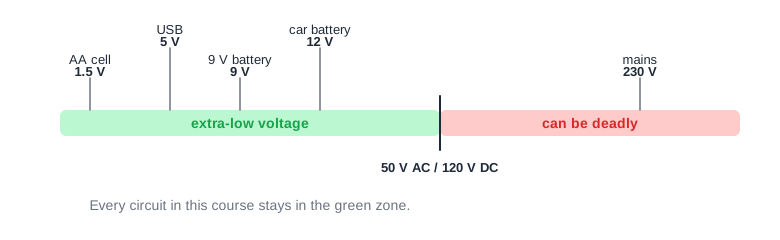
The mains supply, 230 V in Europe, is a different matter. It can drive a deadly current through the body, and it can deliver enough power to start a fire. Mains work belongs to qualified electricians. Even switched-off appliances can be dangerous inside: large capacitors in power supplies can hold their charge after the plug is pulled.
The real dangers of battery circuits
With batteries, the danger isn't a shock. It is heat. A short circuit lets a battery deliver its full current through a wire, which can become hot enough to burn skin or melt insulation. A resistor that is too small for its job gets very hot, as the power page explains. Large batteries make this worse: a car battery or a lithium-ion pack can deliver hundreds of amps into a short circuit.
Lithium-ion batteries need extra care. If they are punctured, crushed, overcharged or short-circuited, they can overheat and catch fire. Use them only with the charger and protection circuit they are designed for.
Rules for the workbench
- Use batteries or a ready-made low-voltage adapter. Never connect your own circuits to the mains.
- Build and change circuits with the power disconnected, and connect the battery last.
- Check for short circuits before connecting the battery, and disconnect at once if anything gets hot or smells.
- Work on a dry, uncluttered table that doesn't burn easily, away from water.
- Never open appliances, chargers or power supplies, even when they are unplugged.
- Children should build circuits with an adult nearby, especially when soldering or using rechargeable batteries.
Homes in Europe usually have a residual current device (RCD) in the fuse box. It compares the current going out to an appliance with the current coming back, and if they differ by about 30 mA, meaning some current is leaking, perhaps through a person, it switches off within a fraction of a second. It is a good last line of defence, not a reason to take risks.
Check yourself
Why can't a 9 V battery give you a shock through dry skin?
Show the answer
Dry skin has a resistance of many thousands of ohms. By Ohm's law, 9 V across that resistance drives only a tiny current, far too small to feel.
What is the main danger in a battery circuit?
Show the answer
Heat. A short circuit or an undersized part lets a large current flow, which can make wires and parts hot enough to burn or melt.
Below which voltages do safety standards speak of extra-low voltage?
Show the answer
Below 50 V AC or 120 V DC.
What does a residual current device do?
Show the answer
It compares the current going to an appliance with the current returning. If they differ by about 30 mA, it switches the power off within a fraction of a second.