Lesson 5 of 6 in On the workbench
How batteries work
By Mihai Dumitru · · 7 min read
Every circuit in this course gets its energy from a battery. The battery life page showed how long one lasts. This page looks inside: what produces the voltage, why different batteries have different voltages, and why a battery's voltage drops when a circuit draws a lot of current.
Cells and batteries
Strictly speaking, a single unit is a cell, and a battery is several cells connected together. An AA is one cell. A 9 V battery is a small box with six cells in series inside, each giving 1.5 V. In everyday language both are called batteries, and that is fine.
What happens inside
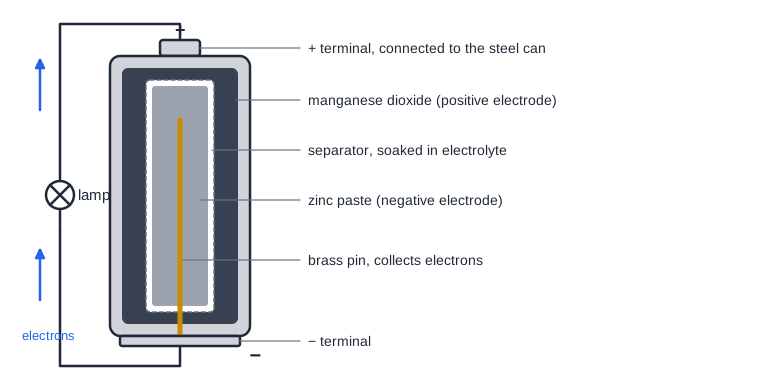
A cell has two different materials, called electrodes, separated by an electrolyte, a paste or liquid that lets charged atoms (ions) move through it but not electrons. The two electrodes react chemically with each other, but the reaction can only go ahead if electrons travel from one electrode to the other. The electrolyte blocks them, so the only route is out through one terminal, around your circuit and back in through the other. That flow of electrons is the current that lights your LED.
In a common alkaline AA cell, the negative electrode is zinc powder in the centre and the positive electrode is manganese dioxide pressed against the inside of the steel can. The can connects to the positive end, the bump at the top. A brass pin in the zinc carries electrons to the flat negative end. As the cell is used, the zinc and manganese dioxide are slowly used up, and once they are gone the cell is flat.
Why 1.5 V
The voltage of a cell is set by its chemistry, not by its size. Each pair of materials pushes electrons with its own strength. That is why a tiny AAA and a big D cell both give 1.5 V: the bigger cell holds more material, so it lasts longer, but it doesn't push harder. Some common types:
- Alkaline (zinc and manganese dioxide): 1.5 V per cell
- Nickel-metal hydride (NiMH), rechargeable AA and AAA: 1.2 V per cell
- Lithium-ion, as in phones and laptops: about 3.6 to 3.7 V per cell
- Lead-acid, as in cars: 2 V per cell, so a 12 V car battery has six cells
To get a higher voltage, cells are connected in series, as described on the battery life page. That is all a 9 V battery is.
Internal resistance
The chemistry inside a cell can't deliver charge infinitely fast. It behaves as if a small resistor were hidden inside, called the internal resistance. When the current is small, it hardly matters. When the current is large, part of the voltage is lost inside the cell and the terminals show less.
Suppose a 9 V battery has 2 Ω of internal resistance and a motor draws 0.5 A. The voltage lost inside is 0.5 × 2 = 1 V, so the motor only gets 8 V, and that lost power warms the battery. Internal resistance rises as a battery runs down, which is why a nearly flat battery can still show 1.4 V on a multimeter but collapse as soon as it has to light a lamp. To judge a battery, measure it while it is powering something.
Rechargeable or not
Alkaline cells are primary cells: their reaction can't be reversed safely, so they are used once. Charging them can make them leak or burst. Rechargeable cells such as NiMH and lithium-ion use reactions that a charger can drive backwards. Each type needs its own kind of charger.
Check yourself
Why does a D cell give the same voltage as an AA cell?
Show the answer
The voltage is set by the chemistry, which is the same. The D cell contains more material, so it holds more charge and lasts longer.
How many cells are inside a 12 V car battery?
Show the answer
Lead-acid cells give 2 V each, so six cells in series.
A battery with 1 Ω of internal resistance supplies 2 A. How much voltage is lost inside it?
Show the answer
2 × 1 = 2 V. The circuit gets 2 V less than the battery's unloaded voltage.
Why can a weak battery read 1.4 V on a meter but fail to light a lamp?
Show the answer
In volts mode the meter draws almost no current, so the high internal resistance of the worn battery doesn't show. The lamp draws a real current, and most of the voltage is then lost inside the battery.