Lesson 2 of 2 in On the workbench
Estimating battery life
By Mihai Dumitru · · · 5 min read
On this page
Once a circuit works, the next question is often how long it will run on batteries. The estimate is a simple division, but the capacity printed on a battery is measured under ideal conditions, so a realistic answer needs a margin. You need to know the current your circuit draws, which you can calculate with Ohm's law or measure as shown in the multimeter guide.
Battery life calculator
Choose a battery and enter how much current your circuit uses to get an estimate of the runtime.
Battery
- Runtime
- 80 h · about 3 days
- Running 2 h a day
- 40 days
Capacity in mAh
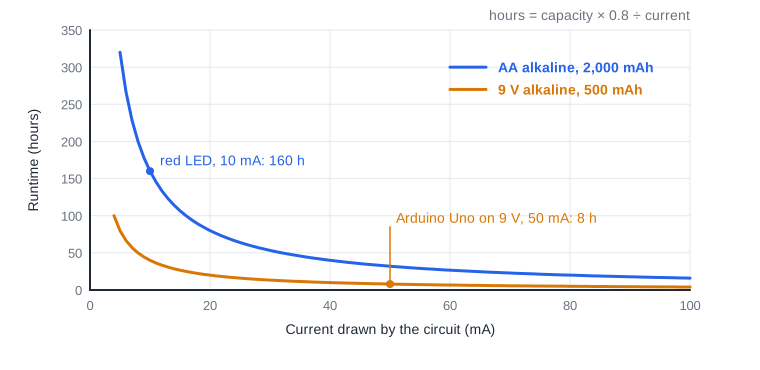
A battery's capacity is given in milliamp-hours (mAh). A 2,000 mAh battery could, in theory, supply 2,000 mA for one hour, 20 mA for 100 hours, or 1 mA for 2,000 hours. The runtime in hours is therefore the capacity divided by the current: hours = mAh ÷ mA.
Why the label is optimistic
- Most circuits stop working before the battery is completely empty, because the battery's voltage drops as it discharges. The charge left at that point can't be used.
- Batteries deliver less of their capacity at higher currents. An alkaline AA gives roughly its rated capacity at a few milliamps, but much less at several hundred.
- Cold reduces capacity considerably.
The calculator therefore uses only 80% of the capacity by default. For motors or anything else that draws a lot of current, lower it to 60% or less.
Typical capacities
- AA alkaline: around 2,000 mAh at low current
- AAA alkaline: around 1,000 mAh
- 9 V alkaline: around 500 mAh
- CR2032 coin cell: around 220 mAh, meant for very small currents
- 18650 lithium-ion: around 2,500 to 3,500 mAh, rechargeable
Two examples
A red LED at 10 mA, powered by two AA batteries in series: 2,000 × 0.8 ÷ 10 = 160 hours, almost a week of continuous light.
An Arduino Uno draws around 50 mA even when it isn't doing much. On a 9 V battery that gives 500 × 0.8 ÷ 50 = 8 hours. That is why a 9 V battery is a poor choice for it. Six AA batteries in a holder last much longer.
Batteries in series and in parallel
- In series, the voltages add up but the capacity stays the same. Two 1.5 V AA cells give 3 V and still about 2,000 mAh.
- In parallel, the capacities add up but the voltage stays the same. Only do this with identical batteries of the same age and charge.
Finding the current
The best input for the calculator is a measured current. Put the multimeter in series with the battery in milliamps mode and measure every state your circuit has: idle, busy, and with every LED or motor on. If your circuit spends most of its time idle, the idle current matters most.
Check yourself
How long can a circuit drawing 25 mA run on a 2,000 mAh AA battery, using 80% of the capacity?
Show the answer
2,000 × 0.8 ÷ 25 = 64 hours.
Two AA cells are connected in series. What voltage and capacity do you get?
Show the answer
In series the voltages add up and the capacity stays the same: 3 V and about 2,000 mAh.
Why is a 9 V battery a poor choice for a circuit that draws 50 mA all the time?
Show the answer
It holds only about 500 mAh. 500 × 0.8 ÷ 50 = 8 hours, while six AA cells would last many times longer.