Lesson 2 of 3 in Step 5 · Electricity and magnetism
How an electric motor works
By Mihai Dumitru · · 7 min read
On this page
A small DC motor, the kind found in toys, fans and toy cars, turns electric current into rotation. It builds directly on the electromagnet from the previous lesson: a coil carrying a current is a magnet, and magnets push and pull each other. This page explains the parts inside a motor, and what that means when you connect one to a battery or a circuit.
The parts
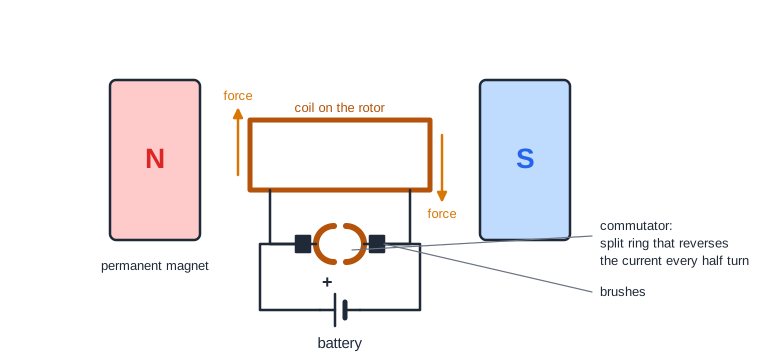
- Permanent magnets fixed to the case, a north pole on one side and a south pole on the other.
- A coil, or several, wound on an iron core that can turn on a shaft between the magnets. This turning part is called the rotor.
- A commutator, a ring on the shaft split into separate segments, each connected to the coil.
- Two brushes, springy metal or carbon contacts that press against the commutator and bring the current in from the battery.
Why it turns
When current flows through the coil, the coil becomes an electromagnet. Its poles are attracted to the opposite poles of the permanent magnets and pushed away from the like poles, so the rotor turns. You can also see it as a force on each side of the coil: a wire carrying a current across a magnetic field is pushed sideways, and the two sides of the coil, carrying current in opposite directions, are pushed in opposite directions.
On its own, that would only turn the coil half a revolution, until its poles faced the opposite magnet poles, and then it would stop. The commutator prevents that. Just as the coil reaches that point, the split ring turns under the brushes, and the current through the coil reverses. The coil's poles swap, the magnets push it on again, and the rotor keeps turning. Real motors use three or more coils and segments, so the turning force stays smooth.
Speed, direction and voltage
A small motor's speed is set mainly by the voltage: higher voltage, faster rotation. To make it turn the other way, reverse the battery. The current through the coil reverses, the forces reverse, and so does the motor.
A spinning motor also works as a generator. As the coil moves through the magnetic field, it produces a voltage of its own that opposes the battery, called the back voltage. The faster the motor spins, the larger it is, so a freely spinning motor draws only a small current. When the motor is loaded and slows down, the back voltage falls and the current rises.
Stall current
If the shaft is held still, there is no back voltage at all. Only the resistance of the coil limits the current, and that resistance is small. A toy motor whose coil measures 3 Ω, on a 6 V supply, draws 6 ÷ 3 = 2 A when stalled, compared with perhaps 0.2 A when running freely. That stall current heats the coil quickly, which is why a motor that is blocked can burn out, and why motor circuits have to be designed for the stall current, not just the running current.
Driving a motor from a circuit
A microcontroller pin can supply only around 20 mA, far too little for a motor. A transistor used as a switch lets the pin control the much larger motor current. A diode across the motor is needed too: when the current is switched off, the coil produces a short high-voltage spike that could destroy the transistor, and the diode gives that spike a harmless path. The relay page in this step explains the spike in more detail.
Many modern motors, in drones, computer fans and electric cars, are brushless. They have no commutator or brushes. Electronics switch the current between fixed coils at the right moments instead, and the magnets sit on the rotor. They last longer and are more efficient, but need a controller circuit to run.
Check yourself
What does the commutator in a DC motor do?
Show the answer
Every half turn it reverses the current through the coil, so the coil's poles swap and the magnets keep pushing it in the same direction of rotation.
How do you make a DC motor turn the other way?
Show the answer
Reverse the voltage. The current through the coil reverses, and so do the forces and the direction of rotation.
A motor's coil measures 4 Ω. What current does it draw on 12 V when the shaft is blocked?
Show the answer
With no back voltage, only the coil limits the current: 12 ÷ 4 = 3 A.
Why does a freely spinning motor draw less current than a stalled one?
Show the answer
The spinning coil acts as a generator and produces a back voltage that opposes the supply. Less voltage is left to push current through the coil.