Lesson 5 of 5 in Step 2 · Working with resistors
Kirchhoff's laws
By Mihai Dumitru · · 7 min read
On this page
Ohm's law tells you the current through one part. As soon as a circuit has several parts, you also need to know how the current and the voltage are shared between them. Two rules do that job. They are named after Gustav Kirchhoff, a German physicist who published them in 1845, and they hold in every circuit you will ever build. This page builds on resistors in series and in parallel.
The current law
A point where two or more wires meet is called a junction, or a node. The current law says that the current flowing into a junction equals the current flowing out of it. Charge does not pile up inside a wire and it does not disappear, so every milliamp that arrives has to leave by one of the paths.
If 30 mA arrives at a junction and the circuit splits into two branches, and one branch carries 20 mA, the other must carry 10 mA. With three branches the same idea applies: the three branch currents add up to the current that came in. Where the branches join again on the other side, the currents add back up to 30 mA.
The voltage law
The voltage law says that if you go once around any closed loop and add up the voltages, the rises equal the drops. A battery is a rise: it lifts the charge to a higher voltage. Every resistor, lamp or LED in the loop is a drop. Put more simply, the supply voltage is shared out among the parts in the loop, and none of it goes missing.
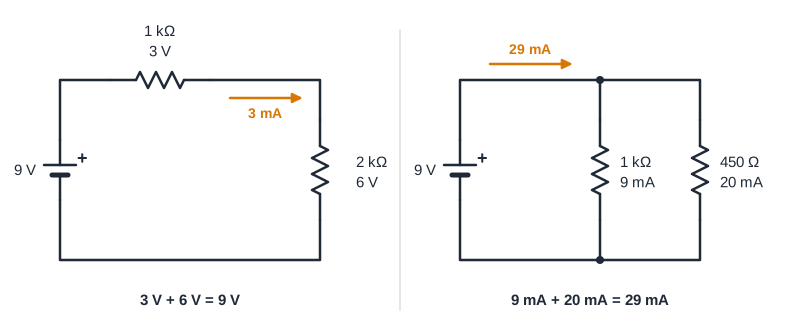
Take a 9 V battery with a 1 kΩ and a 2 kΩ resistor in series. The total resistance is 3 kΩ, so the current is 9 ÷ 3,000 = 3 mA. The 1 kΩ resistor drops 1,000 × 0.003 = 3 V and the 2 kΩ resistor drops 2,000 × 0.003 = 6 V. Together that is 9 V, exactly the battery voltage. The larger resistor gets the larger share, which is what makes a voltage divider work.
Both laws together
Now connect the same 9 V battery to two branches in parallel: a 1 kΩ resistor in one and a 450 Ω resistor in the other. Each branch forms its own loop with the battery, so by the voltage law each resistor gets the full 9 V. Ohm's law then gives 9 mA through the 1 kΩ branch and 20 mA through the 450 Ω branch.
By the current law, the battery has to supply both: 9 + 20 = 29 mA. You can check this with the parallel formula from the previous page. 1,000 and 450 in parallel make (1,000 × 450) ÷ 1,450 = 310 Ω, and 9 V ÷ 310 Ω is 29 mA. Two different routes give the same answer, which is a good sign that the method is right.
The LED resistor, seen again
The formula on the LED resistor page is the voltage law in disguise. A red LED in a 9 V loop keeps about 2 V for itself. The voltage law says the rest, 7 V, must be across the resistor, and Ohm's law turns that 7 V into a resistor value for the current you want. Whenever you calculate the voltage left over for a part, you are using Kirchhoff's voltage law.
When your measurements don't add up
With a multimeter you can check both laws on a real circuit. Measure the voltage across each part in a loop and add the readings. If the sum is clearly less than the battery voltage, look for a hidden drop: a poor contact in a breadboard, a corroded battery clip or a thin wire carrying a large current. These parts have a small resistance of their own, and the voltage law counts them like any other part.
A battery also has some resistance inside it. When the circuit draws a large current, part of the voltage is lost inside the battery and the voltage at its terminals falls. Measure the battery voltage while the circuit is running, not on its own, and use that number when you add up the loop.
Check yourself
40 mA flows into a junction with three branches. Two branches carry 15 mA and 10 mA. What does the third carry?
Show the answer
The currents leaving must add up to 40 mA: 40 − 15 − 10 = 15 mA.
A 12 V battery drives a loop with a 2 kΩ and a 4 kΩ resistor. How much voltage is across each?
Show the answer
The current is 12 ÷ 6,000 = 2 mA. The 2 kΩ resistor drops 4 V and the 4 kΩ resistor drops 8 V, which add up to 12 V.
A 5 V supply feeds a 1 kΩ resistor and a 500 Ω resistor in parallel. How much current does the supply deliver?
Show the answer
Each resistor gets the full 5 V: 5 mA through 1 kΩ and 10 mA through 500 Ω. The supply delivers 5 + 10 = 15 mA.
In a loop with a 9 V battery, a resistor and a red LED, you measure 2 V across the LED and 6.5 V across the resistor. What could explain the missing 0.5 V?
Show the answer
Something else in the loop drops it: a poor contact, a long thin wire, or the battery's own voltage falling under load. Measure the battery while the circuit runs, and check each connection.